
In this post

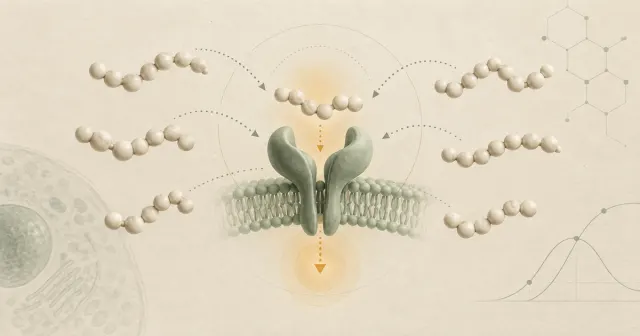
The mature human forms are peptide chains
The reviewed UniProt human record Q9UBU3 names ghrelin-28 and ghrelin-27 as peptides. It places both within a longer starting chain. Peptide bonds join amino-acid units in those forms. The name hormone describes a signaling role. It does not replace the chemical description of the chain.
The 28-unit form occupies positions 24 through 51 in that record. The 27-unit form occupies positions 24 through 50. Both counts include the first and last positions. A one-unit difference is easy to miss when a result says only 'ghrelin' without naming the form.
A study that purified human ghrelin from stomach tissue identified a major 28-unit form and other ghrelin-derived molecules. Its methods concerned separated tissue extracts and laboratory assays. That finding supports the existence of distinct forms. It does not measure what happens to every person with a given blood level.
The 117-unit starting chain
UniProt lists the full reviewed human starting chain as 117 amino-acid units. Its first 23 units form a signal segment. The record then marks shorter processed peptides within the remaining chain. The precursor has 117 units. Mature ghrelin-28 has 28.
The National Center for Biotechnology Information (NCBI) calls the human GHRL gene product a ghrelin and obestatin prepropeptide. That gene name tells us a starting chain can yield more than one named piece. The mature pieces still need their own boundaries and names when a length is quoted.
The same UniProt record marks obestatin at positions 76 through 98. That is 23 units, counted with both endpoints. Obestatin is a separate annotated peptide from the same precursor. A shared gene does not make obestatin another name for ghrelin or establish that their reported effects are interchangeable.
A fatty-acid change adds another distinction
The UniProt record marks a lipid change on serine at precursor position 26. That position is the third unit of ghrelin-28, because its peptide feature starts at 24. One annotated form has an octanoyl group, a fatty-acid part, attached at that serine. The chain remains a peptide after the change.
The human purification study describes the major active 28-unit form as octanoylated at the serine at position 3. The record also describes other ghrelin-derived molecules. A source that says 'acyl ghrelin' refers to a form with a fatty-acid group. A source that says 'des-acyl ghrelin' refers to a form without that group.
Those terms matter when a paper measures receptor signaling. The group can affect activity at the ghrelin receptor. It does not tell the reader that every measured form has the same biological effect. Check the exact form and assay before carrying a result from one paper into another claim.
The human study separated molecules before testing them. It reported forms without an acyl group, with an octanoyl group, and with a decanoyl group. It also described a possible form with an unsaturated group. The study identified these forms with its own methods. Other tests may not separate them. When a result says only 'ghrelin,' check whether the method separated forms before interpreting the result.
Read a length claim in the source record
The comparison below keeps four names from the reviewed human record together. Use the feature name first. Then read its start and end positions. Count both ends to get the length. The position numbers belong to the 117-unit precursor, so they are not positions within the mature peptide.
For example, a note might say, 'Ghrelin has 117 amino acids because UniProt says 117.' That note has joined two different labels. The precursor has 117 units. Ghrelin-28 runs from precursor position 24 through 51. The calculation is 51 minus 24 plus 1, which gives 28 units.
The same calculation gives 27 for positions 24 through 50. It gives 23 for obestatin's positions 76 through 98. This is a way to check an annotated human sequence. It does not test the contents of a vial or determine which form is present in a blood sample.
The position 26 lipid mark needs the same care. It is position 26 on the precursor and position 3 within ghrelin-28. Subtract the peptide start, 24, from 26, then add one. That yields 3. This small check explains why one source writes 'Ser-26' and another writes 'Ser-3' without describing two modification sites.
| Name | Positions in precursor | How to use the number |
|---|---|---|
| Starting chain | 117 units; signal segment at 1–23. | Use 117 only for the full precursor. |
| Ghrelin-28 | 24–51; 51 − 24 + 1 = 28 units. | Use 28 for this mature human peptide form. |
| Ghrelin-27 | 24–50; 50 − 24 + 1 = 27 units. | Keep this shorter form separate from ghrelin-28. |
| Obestatin | 76–98; 98 − 76 + 1 = 23 units. | This is another named peptide from the precursor. |
A shared receptor does not settle chemical class
A receptor is a cell target that can respond to more than one compound. A 2005 laboratory study compared ghrelin and GHRP-6 with two nonpeptide compounds at the ghrelin receptor. It classified ghrelin and GHRP-6 as peptides and MK-677 as nonpeptide. The tested compounds also differed in signaling assays.
The study measured binding and signals in laboratory systems. It did not show that the four compounds have the same structure or the same outcome in people. A search result that groups them by receptor is grouping a target. To answer a peptide question, return to the exact molecule and its chemical record.
GHRP is short for growth hormone-releasing peptide. The site's GHRP guide explains that class of synthetic research compounds. Ghrelin is a natural ligand of the receptor in the cited comparison. A shared receptor name can help locate a paper, but it cannot transfer a study result between these exact compounds.
What to record before using a ghrelin claim
Start with the species and exact name. Write down whether the source names the precursor, ghrelin-28, ghrelin-27, or another processed peptide. If it says acyl or des-acyl, keep that term. Then record what was measured and whether the work used human tissue, people, animals, or isolated cells.
A sequence annotation supports the peptide answer and a length calculation. The human purification paper supports the forms found with its laboratory methods. The receptor comparison supports a narrower finding about activity in its assays. None of these records identifies an offered product or gives a personal treatment decision.
For the title question, the answer stays direct: ghrelin is a peptide hormone. The reviewed human record distinguishes its 28- and 27-unit forms from the 117-unit precursor. Use the exact form when reading a new claim, and seek a source that measures the claimed outcome in the relevant setting.
Common questions
Is ghrelin-27 also a peptide?
Yes. The reviewed human UniProt record marks ghrelin-27 as a 27-unit peptide feature. It is one unit shorter than the marked ghrelin-28 form.
The sources below are the record for this post. It was not independently medically reviewed, and it does not diagnose, prescribe, or recommend treatment.
Sources (6)
Read next
GHRP peptides: class, evidence, and limits
Learn what GHRP peptides are, how GHRP-6 differs from other members and GHRH, and what short human studies cannot prove.

What are peptides?
What peptides are, what they may do, safety limits, uses, and product details.
Photos: Edward Jenner / Pexels (Pexels License)